Baku is one of the world's most surprising cities — a place where medieval fortress walls stand in the shadow of flame-shaped skyscrapers, and where the Caspian Sea meets a skyline that feels equal parts ancient and futuristic. If you only have 48 hours, here is how to spend every one of them well.
Baku defies easy description. It is the capital of Azerbaijan, a country that sits at the crossroads of Europe and Asia, and the city wears that position proudly. In 48 hours you will not see everything — but you will understand why people come back. This guide is built around the way the city actually works: mornings for history, afternoons for architecture and culture, evenings for the boulevard and the skyline.
Day 1: The old city, the skyline, and the night
Morning: Breakfast and Icherisheher
Start the day the Bakuvian way: a traditional breakfast at a downtown cafe. Order pomidor-yumurta (tomato and eggs scrambled together) with fresh tendir bread — the round, slightly charred flatbread baked in a clay oven. Wash it down with strong black tea served in an armudu glass.
From there, walk to Icherisheher — the Old City, also known as the Inner Town. This walled medieval quarter is a UNESCO World Heritage Site and the oldest continuously inhabited part of Baku. Lose yourself in its narrow stone lanes, caravanserais, and ancient mosques. Two sites are essential:
- The Maiden Tower (Qız Qalası): a 12th-century cylindrical fortress whose exact original purpose remains debated by historians. Climb to the top for your first panoramic view of the city and the Caspian.
- The Palace of the Shirvanshahs: a 15th-century royal complex that served as the seat of the Shirvanshah dynasty. The carved stonework is extraordinary.
Allow two to three hours here. The Old City rewards slow walking.
Afternoon: Architecture across the centuries
Baku’s streets outside the Old City are a layered architectural timeline. Head north along Istiglaliyyet and Nizami streets, where 19th-century oil-boom mansions built by Azerbaijani petroleum barons line the pavements. The facades mix Art Nouveau, Gothic Revival, and Baroque — a visual record of the city’s first great wealth.
From there, make your way to the Heydar Aliyev Center, designed by Zaha Hadid and completed in 2012. Its undulating white form — no sharp corners, no straight lines — is one of the most photographed buildings in the region. The permanent collection inside traces Azerbaijani history and craft. Allow 90 minutes.
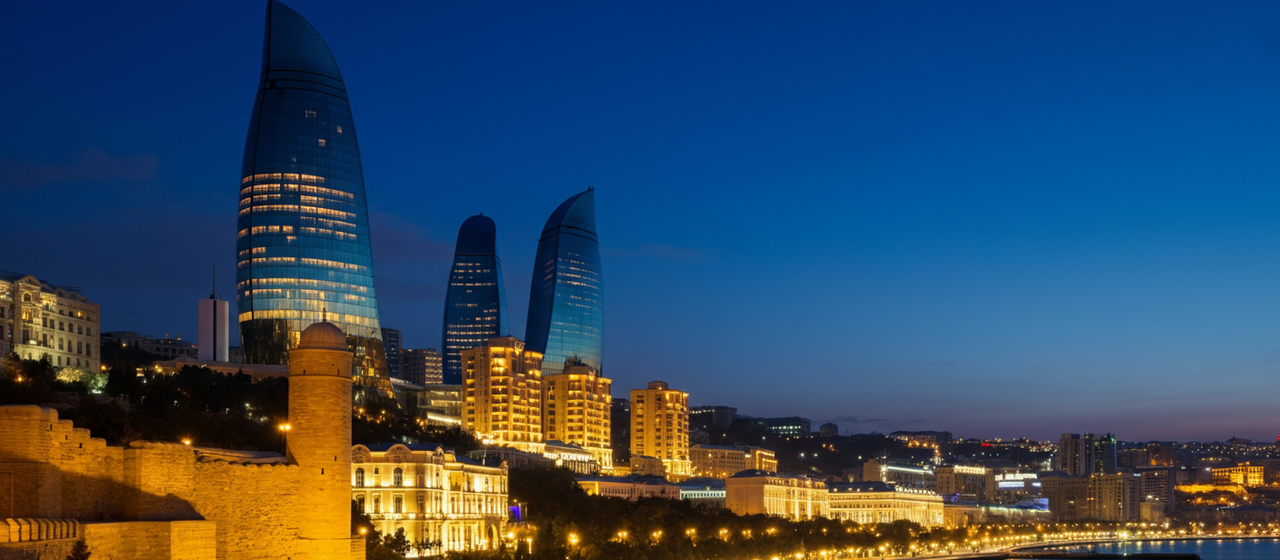
On your way back toward the seafront, look up at the Flame Towers: three glass skyscrapers shaped like flames, lit at night with LED displays that ripple like fire across the Baku skyline. They are best seen from a distance — Highland Park, which you will visit this evening, is the ideal vantage point.
Evening: The boulevard and Highland Park
Baku’s Caspian seafront boulevard (Bulvar) is one of the longest pedestrian promenades in the region. As the sun drops, the city comes alive here. Walk south along the waterfront, past the distinctive roll-shaped Azerbaijan Carpet Museum, and take in the scale of the Caspian — it is the world’s largest inland body of water, and at dusk it turns a deep, metallic blue.
At around 21:30, take the funicular up to Highland Park. The panorama from the top — the Old City below, the Flame Towers blazing, the Caspian stretching to the horizon — is the image of Baku that stays with you. On the way back down, walk through Chemberekend, a quiet historic residential neighborhood, and end the evening at a chaykhana (traditional tea house) with tea, local jams, and baklava.
Day 2: Fire, faith, and farewell
Morning: Ateshgah and the Absheron Peninsula
Baku sits on the Absheron Peninsula, a landscape shaped by natural gas seeping through the earth — the source of the eternal flames that gave Azerbaijan its ancient name, ‘Land of Fire.’ Dedicate your second morning to this geological and spiritual heritage.
Ateshgah Fire Temple, about 30 km from the city center, is a former Hindu and Zoroastrian pilgrimage site built around a natural gas vent that burned continuously for centuries. The flame was extinguished when the gas supply was diverted in the 19th century, but it has since been restored. The complex is small but atmospheric — a reminder that Baku’s fire mythology is not metaphor but geology.
Return to the city by midday.
Afternoon: The spiritual city
Baku’s religious geography is one of its best-kept secrets. In a single afternoon walk, you can pass a functioning Lutheran church, a synagogue-turned-theatre (look for the Hebrew inscription still visible on the facade of the Rashid Behbudov State Song Theatre), the Teze Pir Mosque, and the remnants of a 19th-century Orthodox cathedral demolished in the Soviet era. This is not a city of one faith — it is a city where faiths have coexisted, competed, and left their marks on the same streets.
End the afternoon at Seyid Yahya Bakuvi’s Mausoleum in the Old City, the resting place of the 15th-century Sufi scholar who founded the Khalvati order. It is a place of quiet pilgrimage, visited by Muslims of different traditions.
Evening: A final dinner
For your last meal, seek out a traditional Azerbaijani restaurant in or near the Old City. The national dish is plov — saffron rice cooked with dried fruits, chestnuts, and lamb, served with lavash bread. Order it alongside dolma (grape leaves stuffed with spiced meat and rice) and finish with pakhlava, the diamond-shaped walnut and honey pastry that appears on every Azerbaijani table at celebrations.
Baku’s restaurant scene has grown considerably in recent years, but the best meals are still found in places that have been feeding locals for decades, not the ones with the most Instagram presence.
Practical notes
- Getting around: Baku has a clean, inexpensive metro system. Taxis are widely available and affordable; use the Bolt app for metered rides.
- What to wear: Dress modestly when visiting religious sites. Comfortable walking shoes are essential — the Old City’s cobblestones are uneven.
- Best time to visit: Spring (April–May) and autumn (September–October) offer the most pleasant temperatures. Summer is hot; winter is windy and can be cold.
- Safety: Baku is a safe city for solo travelers, including at night. The boulevard and Old City are well-lit and well-populated in the evenings.
- Language: Azerbaijani is the official language; Russian is widely spoken. English is increasingly common in hotels, restaurants, and tourist areas.
- Currency: The Azerbaijani manat (AZN). Cards are accepted in most restaurants and hotels; carry some cash for markets and smaller cafes.
Beyond 48 hours
If you have more time, Gobustan National Park — 60 km southwest of Baku — offers prehistoric petroglyphs and mud volcanoes in a landscape that feels genuinely otherworldly. The mountain town of Sheki, a four-hour drive northwest, is one of the most beautiful places in the Caucasus. And if you want to go deeper into Baku itself, Trip8’s local experts offer guided itineraries covering architecture, spiritual heritage, and the city after dark — each one designed by someone who has lived here their whole life.
Work with a local expert to design a custom itinerary based on what inspired you here.
Plan this trip